Lyophilized peptides arrive at the bench as a stable, glassy solid — but the integrity of every downstream experiment depends on how that material is received, reconstituted, divided, and stored. Peptides are chemically reactive species. Their primary sequences include residues prone to oxidation, deamidation, aggregation, and adsorption, and many lose activity rapidly once they enter aqueous solution. A disciplined protocol is not bureaucratic overhead; it is the difference between reproducible in-vitro data and irreproducible noise.
This guide describes laboratory handling practices for lyophilized research peptides used strictly in non-clinical, in-vitro, and analytical settings. It addresses receiving, reconstitution principles, aliquoting, cold-chain storage, freeze-thaw management, stability, and documentation. It does not address human administration, dosing, or any therapeutic use, and nothing here should be read as guidance for such use.
Reconstitution is the single highest-leverage step in a peptide workflow. Decisions made in the first ten minutes after a vial is opened determine the usable lifetime of the entire lot.
Receiving and Inspecting Lyophilized Material
Treat receiving as the first experimental step, not a logistics formality. When a shipment arrives, inspect it before logging it into inventory.
- Confirm the cold chain. Many lyophilized peptides ship on ambient or with cold packs because the dry solid is comparatively stable, but verify the supplier's stated shipping condition and note any temperature excursion or fully melted coolant.
- Inspect the vial and cake. A well-lyophilized peptide typically presents as a white-to-off-white powder or a uniform cake. Note any collapse, melt-back, discoloration, or visible moisture, which can indicate vacuum loss or thermal stress.
- Reconcile the paperwork. Match the compound name, sequence, net peptide content, salt form, lot number, and quantity against the packing list and the Certificate of Analysis (COA).
- Review the lot-specific COA. Confirm HPLC purity, identity by mass spectrometry (typically ESI-MS), and any reported water or counterion content. Retain the COA as the anchor record for that lot.
Equilibrate Before Opening
Cold vials taken straight from a freezer will draw atmospheric moisture onto the cold glass and the hygroscopic solid the moment they are opened. Allow sealed vials to warm to room temperature — often 20 to 30 minutes — before breaking the seal. This single habit prevents avoidable hydrolysis and clumping of the lyophilized cake.
Reconstitution Principles
Reconstitution converts a stable solid into a reactive solution, so it should be deliberate and documented. The goal is to fully dissolve the peptide without introducing degradation, contamination, or adsorptive loss.
Selecting a Solvent
Solubility is sequence-dependent. Hydrophilic peptides often dissolve readily in laboratory-grade water or buffer, while hydrophobic or aggregation-prone sequences may require a small fraction of a co-solvent to initiate dissolution before dilution into the working buffer. General considerations include:
- Sterile water or an assay-appropriate buffer is a common choice for research stock solutions; verify compatibility with the intended assay.
- Acidic or basic conditioning can aid dissolution of certain sequences, but extremes of pH accelerate deamidation and hydrolysis and should be minimized and neutralized promptly.
- Organic co-solvents (for example, a minimal percentage of acetic acid or DMSO) may be needed for poorly soluble or cysteine-containing peptides — but DMSO can promote oxidation or disulfide scrambling in some sequences and should be evaluated case by case.
- Buffer choice should reflect the assay; phosphate, acetate, or other buffers near neutral pH are common, with the recognition that metal-binding compounds such as copper peptides interact strongly with certain buffer systems.
Technique
Add solvent slowly down the inner wall of the vial rather than directly onto the cake, and let the peptide dissolve by gentle swirling or brief, low-energy agitation. Avoid vigorous vortexing and foaming, which shear and denature sensitive sequences and drive surface adsorption. Do not sonicate aggressively. Allow a few minutes for full dissolution; if particulate persists, record it rather than forcing it into apparent solution.
Calculate concentration from the net peptide content on the COA, not the gross vial mass. Lyophilized peptides carry counterions (commonly acetate or trifluoroacetate) and residual water, so the actual peptide mass is typically less than the weighed solid. Failing to correct for net content is one of the most common sources of concentration error in research stocks.
Aliquoting to Protect the Stock
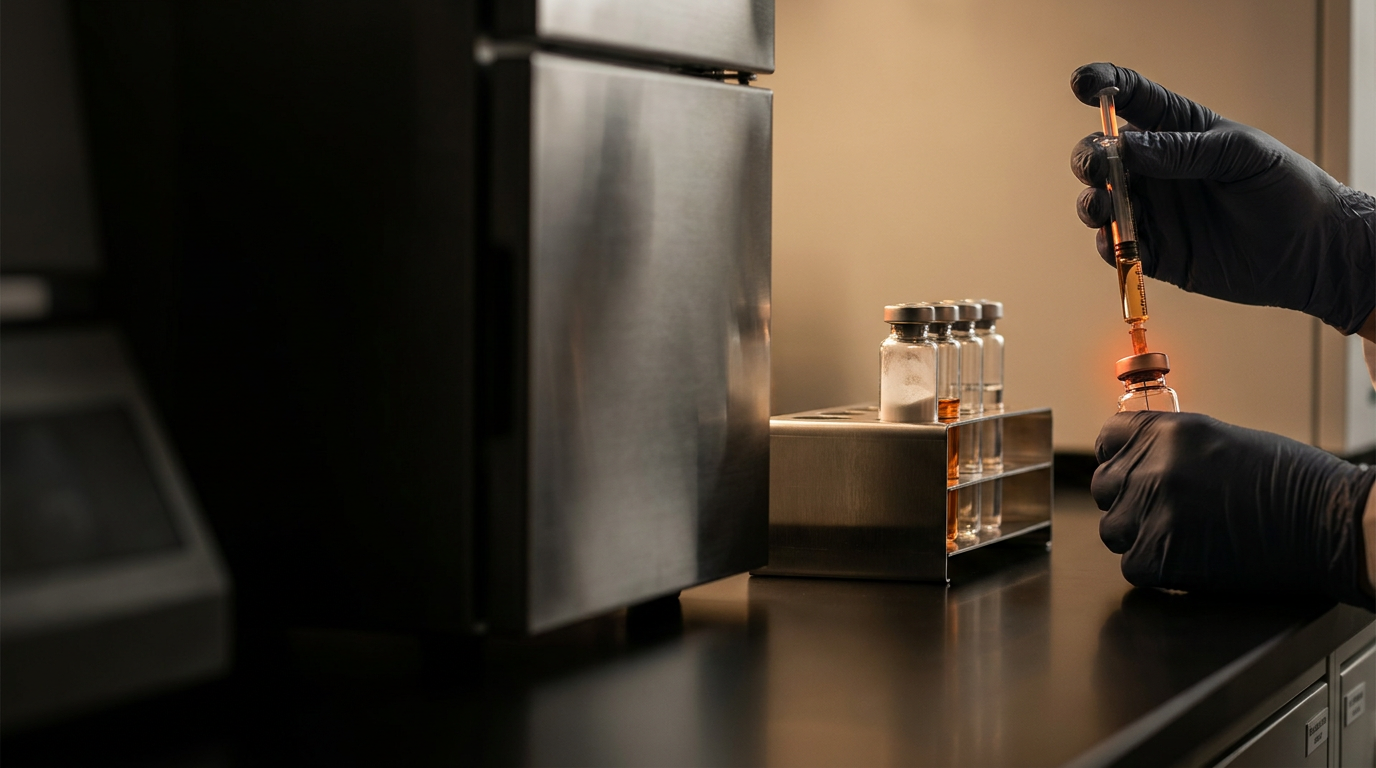
Once reconstituted, the enemy is repeated handling. Every time a stock is thawed, opened, and refrozen, it accumulates degradation. The remedy is to aliquot the working stock immediately into single-use or limited-use volumes.
- Divide the freshly reconstituted solution into small aliquots sized to typical experimental use, so that no aliquot is thawed more than necessary.
- Use low-protein-binding tubes where adsorptive loss is a concern, particularly for dilute solutions and surface-active sequences.
- Label every aliquot with compound, lot number, concentration, solvent, date, and operator initials. A rack of identically capped cryovials with no labels is a reproducibility failure waiting to happen.
- Consider whether a stabilizing additive or carrier protein is appropriate for very dilute stocks, balancing assay compatibility against adsorptive loss.
Aliquot once, freeze once, thaw once. Design the aliquot volume around the experiment so the freeze-thaw count for any given tube stays as close to one as possible.
Cold-Chain and Long-Term Storage
Storage strategy differs sharply between the dry solid and the reconstituted solution.
Lyophilized Solid
The dry, sealed peptide is the most stable form. For long-term holding, store lyophilized material cold — commonly at −20 °C, and at −80 °C for extended storage of sensitive sequences — protected from light and moisture, ideally with desiccant. Keep the vial tightly sealed and minimize the number of times it is opened. Many lyophilized peptides remain stable for extended periods under these conditions, but always defer to the lot-specific stability information.
Reconstituted Solution
Solutions are far less stable than the solid. Short-term working stocks are typically held refrigerated at 2 to 8 °C for limited periods (often days), while longer holds use frozen aliquots at −20 °C or −80 °C. Important practices:
- Avoid frost-free freezers for critical stocks; their automatic warming cycles subject contents to repeated micro freeze-thaw.
- Store frozen aliquots in a defined, mapped freezer location so material can be retrieved without prolonged thawing of the surrounding rack.
- Protect light-sensitive and oxidation-prone sequences (for example, those containing methionine, cysteine, or tryptophan) from light and air exposure.
Managing Freeze-Thaw and Stability
Freeze-thaw cycling is a leading cause of peptide degradation in research settings. Ice-crystal formation, local pH shifts during freezing, and repeated air exposure all promote aggregation, oxidation, and adsorptive loss. Mitigate it structurally:
- Thaw aliquots on ice or at controlled refrigerated temperature rather than at room temperature or under hot water.
- Mix gently after thawing; do not vortex thawed peptide solutions harshly.
- Track a freeze-thaw count per aliquot and retire aliquots that exceed a predefined limit established for that compound.
- Where stability is uncertain, run a small bridging study — analyze purity by HPLC over time and storage conditions — to define a defensible in-house shelf life for that lot rather than assuming indefinite stability.
Visible cues such as cloudiness, precipitate, or color change warrant analytical follow-up before the material is used in an experiment. Analytical confirmation, not appearance alone, is the standard for deciding whether a stock remains fit for research use.
Documentation and Lot Traceability
Reproducibility lives in the record. Every reconstitution and aliquoting event should be logged so that any result can be traced back to a specific lot and preparation. A minimal traceability record includes:
- Compound name, sequence, and salt form
- Supplier lot number and the linked COA (HPLC purity, ESI-MS identity, third-party testing where available)
- Reconstitution date, solvent, final concentration, and net-peptide correction used
- Aliquot inventory, storage location, and freeze-thaw history
- Operator identity and any deviations or observations
This chain — COA to stock to aliquot to experiment — lets a laboratory reconcile anomalous data against material history and supports the kind of rigorous, auditable workflow expected in institutional research. Across categories from Tissue Repair & Regeneration to Hormonal Regulation and Metabolic & Weight Management research compounds, the handling discipline is the same: the value of a peptide as a research tool is only as good as the records that accompany it.
References
- United States Pharmacopeia (USP) — General chapters on lyophilization, peptide identity, and impurities.
- International Council for Harmonisation (ICH) Q1A(R2) — Stability testing principles.
- Journal of Pharmaceutical Sciences — Peer-reviewed literature on peptide degradation pathways (oxidation, deamidation, aggregation).
- Analytical Chemistry / Journal of Chromatography A — Methods for HPLC purity and ESI-MS identity confirmation of peptides.
- National Institute of Standards and Technology (NIST) — Reference materials and good measurement practice guidance.
For Research Use Only — Not for human use or consumption. The information above pertains to in-vitro and laboratory research workflows and is not intended as medical, clinical, diagnostic, or dosing guidance.